Showing posts with label Censorship. Show all posts

Wednesday, July 31, 2013

Lozano-Hemmers installation celebrating free speech runs into NYPD censorship


Rafael Lozano-Hemer is turning the Park Avenue tunnel in New York into a reverberating sound and light installation celebrating free speech. Visitors will find a silver intercom to speak into and their comments will pulse through the tunnel in waves of sound and light. However, the NYPD has voiced concerns about content and has asked the artist to install a time delay so comments can be regulated. Lozano-Hemmer has refused to play ball saying "This is the place for people to express their views...I've never in my life censored a work, and I won't do it."
Image: Rafael Lozano-Hemmer's voice tunnel, Park Avenue tunnel NYC, 3-18 August 2013

Tuesday, December 18, 2012

China's Ministry of Culture rejects Warhol's Mao works


Andy Warhol's images of Chairman Mao won't be part of a traveling exhibition of his work when it goes to China. According to Bloomberg, the Mao works have been rejected by the Ministry of Culture. If mainland fans of Warhol want to see silkscreens of the great helmsman they will have to catch the Hong Kong leg of Andy Warhol: 15 Minutes Eternal. Read more...
Image: Andy Warhol's Mao

Tuesday, December 11, 2012

Jake and Dinos Chapman installation under investigation in Russia


Russian prosecutors have launched an investigation into whether an installation by Jake and Dinos Chapman exhibited at St Petersburg's Hermitage Museum is in breach of the country's extremism laws. Read more...
Image: Jake and Dinos Chapman installation at White Cube

Monday, August 27, 2012

Gallery says artist's film will be off-limits to men, despite advice from the Human Rights Commission that it could be seen as sexual discrimination


The Dowse Art Museum is preparing to screen Qatari writer and filmmaker Sophia Al-Maria's film Cinderazahad: For Your Eyes Only in the exhibition In Spite of Ourselves: Approaching Documentary. In line with the artist's wishes, men will not be able to view the film, which features female family members and friends getting ready for a cousin's wedding, without wearing hijabs.

In a statement, Al-Maria said images from the film were from exclusively female zones inside a home. "They, like this work, should be treated as privileged and private, for women's eyes only."

Dowse director Cam McCracken has confirmed that the film will be off limits to men, in the face of advice that the museum's decision may be subject to a complaint to the Human Right Commission for preventing access to a sector of the public based on gender. "We respect the artist and the privacy of the women who are portrayed," he said."I haven't seen the work, and I won't."

And Islamic Women's Council of New Zealand spokesperson Rehanna Ali says: "We hope it promotes some interesting discussion, rather than reactive controversy. I think that as a country we are quite mature now in the recognition of the diversity of the community we have here."

Friday, July 27, 2012

India asks Ullens Centre for Contemporary Art to remove a politically sensitive work from Indian Highway exhibition


Video artist Tejal Shah's art work I Love my India has been removed from the Indian Highway exhibition at the Ullens Centre for Contemporary Art in Beijing - not at the request of the Chinese government, but rather one from Indian Government officials. The work depicting Muslims talking about the Godhra riots upset the sentiments of the Indian community in China leading the Indian Ministry of external Affairs to intervene.

The exhibition curated by Julia Peyton-Jones, Hans Ulrich Obrist and Gunnar Kvaran opened at Serpentine in 2008 and traveled to venues in Oslo, Lyon and Rome without incident before its Bejing outing at the UCCA. Neither of the institutions has commented on the removal of the video which focuses, according to a description by the Serpentine, on "the ignorance and lack of understanding of the genocide against the Muslim minority in 2002."
Image: A video still from Tejal Shah's I Love my India

Tuesday, December 13, 2011

The end of the controversy surrounding A Fire in My Belly?

When David Wojnarowicz's video A Fire in My Belly hit the headlines following the Smithsonian's decision to withdraw it from Hide/Seek: Difference and Desire in American Portraiture at the Smithsonian's National Portrait, many commentators talked about a return to the culture wars of the 1990s.

However, this time the controversy has played out differently from the era when Jesse Helms was railing against gay rights and contemporary art.The video made it onto YouTube, reaching millions of viewers who were previously unaware of its existence, MoMA acquired it for its permanent collection, the New Museum showed it continuously in its lobby, it was featured in an event at the Tate Modern to reconsider Wojnarowicz's work in the light if efforts to distort its intentions and legacy, and when the Catholic Bishop of Brooklyn, Nicholas DiMarzio reignited the controversy calling for A Fire in My Belly to be removed from Hide/Seek at the Brooklyn Museum the director of the Museum refused to withdraw the work.

This link takes you to an article in the Financial Times Hide/Seek: Difference and Desire in American Portraiture and the controversy surrounding David Wojnarowicz's work.
Image: David Wojnarowicz, A Fire in My Belly (1987), video still

Monday, November 21, 2011

Curator defends artist's use of imagery of Christ's crucifixion as a metaphor for human suffering

The Brooklym museum is refusing to budge in the face of calls for David Wojnarowicz's video A Fire My Belly to be removed from the Hide/Seek exhibition, saying the artwork is "an expression of the artist's outrage at indifference to human suffering during the early years of the AIDS crisis.

The co-curator of the exhibition, Jonathan Katz, has also weighed in saying the work belongs to a centuries-old tradition of using the imagery of Jesus Christ's crucifixion as a metaphor for human suffering. "What gets lost in all this brouhaha is how thoroughly informed he is by a Catholic iconographic tradition and how he is reinvigorating it to describe new social realities" Katz said of the artist. "This is a work of art of great complexity and sensitivity."
Image: David Wojnarowicz, A Fire in My Belly (1987), video still

Sunday, November 20, 2011

Brooklyn bishop calls for A Fire in My Belly to be banned


The Catholic Bishop of Brooklyn, Nicholas DiMarzio, is fueling the furore over David Wojnarowicz's video A Fire in My Belly, calling for it to be removed from the Hide/Seek exhibition at the Brooklyn Museum on the grounds that it is a disrespectful and blasphemous attack on their religion. In a strangely telling video statement on the web Bishop DiMarzio says that he admires Wojnarowicz's identification with the suffering Christ but that he shouldn't be allowed to express it publicly in art. Read more...
Image: Bishop Nicholas DiMarzio and David Wojnarowicz

Monday, November 14, 2011

Sacrilege and the sacred: round two


David Wojnarowicz's video A Fire in My Belly is drawing flak from Catholic groups as the National Portrait Gallery's Hide/Seek exhibition heads to the Brooklyn Museum. So far Brooklyn's Catholic Diocese has requested the work be censored from the show, the Daily News is fueling tabloid-ready outrage in advance, and Brooklyn Museum director Arnold Lehman says he has received thousands of pre-programmed emails in protest.

This link takes you to our earlier posts on the Smithsonian's controversial decision to withdraw A Fire in My Belly from the Washington showing of Hide/Seek: Difference and Desire in American Portraiture.
Image: David Wojnarowicz, A Fire in My Belly (1987), video still

Monday, October 3, 2011

Arab Spring-inspired work called off by London authorities


While the wave of civil uprising and resistance washing over North Africa and the Middle East is supported by the West (the Arab Spring is now the focus of speculation over this year's Nobel Peace Prize), it isn't always embraced closer to home. Last week London's Westminster council called off Egyptian artist Moataz Nasr's plan to cut the Kufic inscription "The people want the fall of the regime" (a chant of Arab Spring demonstrators) into a grass lawn at Mayfair's Hanover Square claiming the protests were still too raw.
Images: Protest in Egypt and Moataz Nsar's The Maze, 2011

Thursday, April 28, 2011

Censored Algerian artist talks about his part in the Sharjah Biennial controversy


Recently, Jack Persekian, director of the Sharjah Art Foundation, an umbrella organisation overseeing the biennial, was sacked by Sharjah ruler Sheik Sultan Bin Mohammad Al Qasimi. The reason, according to the Foundation, was a "public outcry" caused by the inclusion of an artwork by Algerian artist and writer Mustapaha Benfodil, an installation consisting of mannequins in soccer uniforms emblazoned with Arabic phrases that were deemed blasphemous.

The art world has been quick to gather around Persekian. An online petition is currently circulating to show support for the administrator and condemn the censorship. Persekian, however, disavows the the petition. "I have not authorised the online petition that has been launched in my name by certain people associated with the Sharjah Art Foundation," he said. "I am not an advocate of boycotting any institutions to effect changes in the Middle East art scene. I have always believed in the benefits of respectful dialogue and routine interactions to effect change. Those personal beliefs still apply today and going forward into the future for the Sharjah Art Foundation and its artists."

So far, the media focus has been on the act of censorship and firing of Persekian. However, ART INFO UK caught up with the artist in London to discuss his work and hear his version of the story. You can read the interview here.
Image Mustapha Benfodil's Maportaliche/It Has No Importance 2011, before it was removed from the Sharjah Biennial

Thursday, April 21, 2011

Serrano's Piss Christ attacked by Christian fundamentalists


Controversy has followed Andres Serrano's Piss Christ ever since he plunged a plastic crucifix into a glass of his own urine and photographed it, but it reached an unprecedented peak on Palm Sunday when it was attacked with hammers and destroyed after an "anti blasphemy" campaign by French Catholic fundamentalists in the city of Avignon, The Guardian reports that the violent slashing of the picture, and another Serrano photograph of a meditating nun, has plunged France into soul-searching about Christian Fundamentalism and Nicolas Sarkozy's use of religious populism in his bid for re-election next year. Read more...
Image: Andres Serrano, Piss Christ (1989)

Friday, April 1, 2011

The Museum of Censored Art


The Museum of Censored Art was the brainchild of Michael Blasenstein and Michael Iacovone, the duo who were banned from all Smithsonian museums following their attempt to show David Wojnarowicz's video in the National Portrait Gallery after it had been removed from the institution's Hide/Seek exhibition on the history of gay identity in art. They screened A Fire in My Belly in the Gallery on an iPad suspended around Blasentein's neck with Iacovone shooting a video of the action.

Blasenstein and Iacovone later set up the Museum of Censored Art in a trailer outside the National Portrait Gallery where they attracted over 5,000 visitors to daily screenings of the censored video.

This link takes you to Wounded in the Crossfire of a Capital Culture War, the NYT's latest story on the collision of art and politics at the Smithsonian.
Image: The Museum of Censored Art set up outside the Smithsonian's National Portrait Gallery to screen David Wojnarowicz's video A Fire In My Belly.

Thursday, March 31, 2011

"The culture wars are back"


The National Portrait Gallery's Hide/Seek exhibition has closed but the controversy around Smithsonian director Wayne Clough's decision to remove a work by David Wojnarowicz from the show lingers on. The Smithsonian has said it will host a forum on the lessons learned from the dispute in April, but the details have yet to be released. Meanwhile the Corcoran Gallery of Art has hosted an all-day symposium on the issues raised by the affair titled Culture Wars: Then and Now. The keynote speaker was Robert Storr, who declared that "the culture wars are back" according to the Washington Post.

Recently the advocacy group People for the American Way also put out a lengthy report proposing lessons for museums gleaned from the Hide/Seek affair titled How Not to Respond to Political Issues: Lessons from the Smithsonian's Response to the Manufactured Right-Wing Controversy over Hide/Seek. The new report seeks to address the sense that the Smithsonian is trying to sweep the issues raised by censorship under the carpet.

The report offers five helpful bullet points for museums seeking to respond to future flare-ups:
  • Don't panic: have a plan and follow it (a piece of common sense Clough has a history of ignoring);
  • Defend core principles (of which freedom of expression should be a core one)
  • Understand and expose your opponents (exposing extremist records, anti-freedom agendas and general disregard for truth demonstrated by right-wing culture warriors can undermine the impact of their attacks);
  • Embrace debate (the best response to irresponsible speech is more speech... Short-circuiting debate by trying to avoid controversy prevents arts institutions from having a potentially transformative impact on public debate);
  • Demonstrate accountability (ie Clough should have been fired for his admitted mismanagement).
You can read our earlier posts on the controversy here.
Image: The temporary Museum of Censored Art located outside the Smithsonian's National Portrait Gallery to show David Wojnarowicz's video A Fire in My Belly

Friday, January 21, 2011

Clough defends removal of A Fire in My Belly


Wayne Clough has defended his decision to remove A Fire in My Belly from Hide/Seek: Difference and Desire in American Portraiture, a major show on sexual identity in portraits at the Smithsonian's National Portrait Gallery. Speaking for the Smithsonian, he said: "We are not here to cause controversy. We are here help people understand these issues that are important to our growth as a society."

Clough has decided to hold a public forum in April to discuss all the issues that have been raised. "I know we have to continue a dialogue," he sad. "Some of the issues to be discussed are the difference between publicly funded and private museums, their approaches to exhibitions and the role of the Smithsonian as a national leader."
Image: National Portrait Gallery

Thursday, January 20, 2011

MoMA acquires controversial Wojnarowicz video


The Museum of Modern Art has acquired the David Wojnarowicz video that was removed from an exhibition at the National Portrait Gallery in Washington after the Smithsonian's top executive G. Wayne Clough bowed to pressure from the New York-based Catholic League and congressional Republicans who objected to the work because it was "anti-Christian".

Wojnarowicz, who died of AIDS in 1992, made A Fire in My Belly in the late 1980s in response to the AIDS crisis. It was included in an exhibition at the National Portrait Gallery (a Smithsonian museum) examining gay themes in American portraiture.
  
Last week artist AA Bronson joined the fray asking for his piece to be removed from the show in protest. His lawyer has sent a letter to Clough and the director of the National Portrait Gallery, Martin E. Sullivan, threatening legal action if the museum does not comply. 

Meanwhile A Fire in My Belly is being shown at MoMA in a collection show that runs to 9 May 2011 and it will feature in an event at the Tate Modern on 22 January to reconsider Wojnarowicz's work in the light of efforts to distort its intentions and legacy.
Image: David Wojnarowicz, A Fire in My Belly (1987)video still

Sunday, December 19, 2010

Tate Modern says Wojnarowicz's work remains a crucial, inspiring response to the mortality, decay and rage that defined his era

While artists, foundations and activists continue to protest the Smithsonian's decision to pull David Wojnarowicz's video from an exhibition at the National Portrait Gallery, many museums, including the Tate Modern, are lining up to show the disputed video.

The Tate Modern will present a selection of films and readings to reconsider David Wojnarowicz's powerful work in the light of recent efforts to distort its intentions and legacy. The programme will include A Fire in My Belly plus Wojnarowicz's collaboration with Ben Neill, ITSOFOMO (in the shadow of forward motion). Other material will be screened along with readings of the artist's writings by local artists and writers. 

This link takes you to the Tate's release on the Wojnarowicz event scheduled for 22 January 2011.
Image: David Wojnarowicz, A Fire in My Belly (1987)video still

Wednesday, December 15, 2010

Andy Warhol Foundation steps into art censorship debate

The Andy Warhol Foundation has threatened to to end Smithsonian funding unless the David Wojnarowicz video A Fire in My Belly is restored to the exhibition Hide/Seek: Difference and Desire in American Portraiture at the Smithsonian's National Portrait Gallery, but the Smithsonian is refusing to budge.
Image: Protestors hold mask in support of artist David Wojnarowicz on the steps of the Smithsonian's National Portrait Gallery

Monday, December 13, 2010

Sacrilege and the sacred


The New York-based Catholic League, a self-described civil rights organisation at the forefront of the fight to remove David Wojnarowicz's video A Fire in My Belly from the exhibition Hide/Seek: Difference and Desire in American Portraiture, has changed tactics this week. Originally objecting to the video that League president William Donohue described as "anti-Christian", the organisation now says that museums should have all federal funding pulled because "they cater to the affluent and well educated rather than to the working class". 

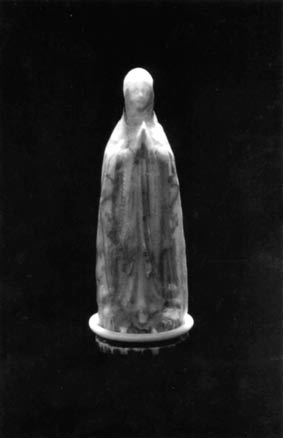
The controversy surrounding Wojnarowicz's video echoes the furore that erupted in New Zealand in 1998 when Te Papa Tongarewa the Museum of New Zealand presented Tania Kovats' Virgin in a Condom in the Pictura Britannica exhibition. New Zealand's Catholic community was outraged by the small statuette of the Virgin Mary sheathed in a condom. This followed the 1997 closure of the Andres Serrano exhibition at Melbourne's National Gallery of Victoria after a second attack on the artist's controversial work Piss Christ, death threats to staff and an alleged concern for a Rembrandt exhibition that was on at the time.   

The Catholic League's latest move (going after the museum project) also echoes the tactics of Catholics and evangelical Christians in New Zealand who questioned the national museum's double standards, pointing out that Te Papa (Maori for Our Place) had engaged in a lengthy process of consultation with Iwi aimed at developing a bicultural museum, but was unwilling to do the same for other communities of interest. They said the museum took great care to observe Maori spiritual values but ran roughshod over Christian values. 

Te Papa officials dug in, refusing to budge in the face of daily protests outside the museum and a 33 thousand-signature petition demanding the removal of Virgin in a Condom. But while the art world supported the museum's refusal to bow to pressure, many also felt that by its unwillingness to enter into an open debate Te Papa lost an early opportunity to foreground the museum's role as a forum - a place where ideas could be presented, tested and contested. 

The trans-Tasman responses in the late 90s (closing an exhibition in Melbourne v. an unproductive stand-off in Wellington) were less than ideal so it'll be interesting to see how the current controversy generated by Wojnarowicz's searing meditation on aspects of the AIDS pandemic plays out in the States.

This link takes you to a Backchat panel discussion screened by TVNZ in 1998 on Virgin in a Condom, the sacred and the profane, and art museums and controversy.
Images from the top: David Wojnarowicz, A Fire in My Belly (1987)video still; Tania Kovats, Virgin in a Condom (1992); Andres Serrano, Piss Christ (1989)

Thursday, December 9, 2010

Decision to censor video draws flak


The Association of Art Museum Directors (AAMD) has issued a strongly worded rebuke to the Smithsonian Institution and the National Portrait Gallery in Washington DC, for censoring a video by David Wojnarowicz in the critically acclaimed exhibition Hide/Seek: Difference and Desire in American Portraiture, reports Christopher Knight for the Los Angeles Times.

The video, A Fire in My Belly, is a searing meditation on aspects of the AIDS pandemic and the decision to remove it came in the wake of calls by the House speaker-designate John Boehner and incoming majority leader Eric Cantor to dismantle the privately funded exhibition.

The AMMD statement described the Smithsonian's decision as having resulted from political pressure.

"More disturbing than the Smithsonian's decision to remove this work is the cause: unwarranted and uninformed censorship from politicians and other public figures, many of whom, by their own admission, have seen neither the exhibition as a whole or this specific work. The AAMD believes that freedom of expression is essential to the health and welfare of our communities and our nation. In this case, that takes the form of the rights and opportunities of our art museums to present works of art that express different points of view."
Image: video still from David Wojnarowicz's video A Fire in My Belly