Showing posts with label Shanghai art museums. Show all posts

Wednesday, October 22, 2014

Shanghai's must-see museums: Long Museum


The Long Museum is the the last of the museums we visited during a recent trip to Shanghai. Established by collector Wang Wei and her billionaire husband Liu Yiquan, it is the largest privately-owned museum in China, spanning over 33,000 square metres with 16,000 square metres of exhibition space.

The museum has adopted a novel approach to programming. Rather than appointing curators, well-known domestic and foreign curators are invited to work with an in-house academic department to develop concepts into exhibitions. The concept for the current exhibition, About 1199 People (which was being installed while we were there), was developed by artist Xu Zhen with Hans Ulrich Obrist. Xu selected the works (all from the Long Museum collection) and he and Obrist will discuss the exhibition and related topics in conversations to be published in the exhibition catalogue.

While we didn't see About 1199 People, we did visit the galleries dedicated to museum's exceptional collection of traditional Chinese art, which along with the striking architecture and gigantic, vaulted spaces for contemporary art makes it one of Shanghai's must-see art museums.
Images: Long Museum (West Bund) interior; Lv Ji, Ming Dynasty, 168.6 x 97cm (detail); Song Huizong, Northern Song Dynasty, ink on paper, 27.5 x 525cm

Friday, October 17, 2014

Shanghai's must-see museums: Rockbund Art Museum


Near Shanghai's fabled Bund, you can find Thomas Ou's Rockbund Art Museum housed in a beautifully restored 1933 Art Deco building that was at one time home to the Royal Asiatic Society. The Rockbund is a comparatively small, but innovative space with a impressive record of shows with artists and curators such as Cai Guo-Qiang, Zheng Fanshi, Paola Pivi, Hou Hanru and Fumio Nanjo among others.

The Rockbund is currently showing Ugo Rondinone's Breathe, Walk, Die, an installation staged over five of the gallery's floors. The walls are painted floor to ceiling with colours that move from cool to warm in tandem with the coloured filters on the windows. Each floor has circular canvases of blurred concentric colours, all combining to form a backdrop for 40 impassive clowns doing nothing. It's a beautiful, but disturbing piece -  the best show in town, in the smallest museum space, and proof (in a ciiy known for its massive museums) that bigger isn't always better.
Images: Ugo Rondinone's Breathe, Walk, Die at Shanghai's Rockbund Art Museum

Thursday, October 16, 2014

Shanghai's must-see art museums: Power Station of Art


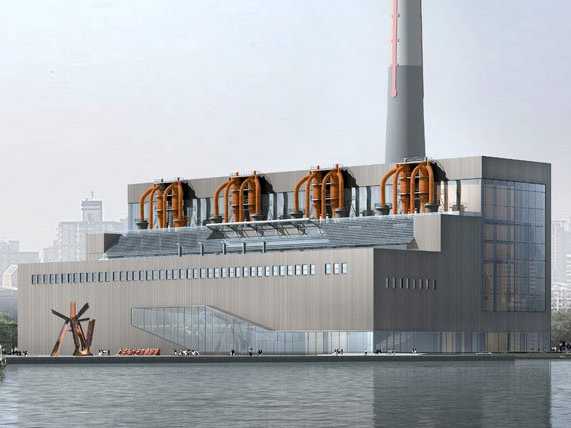
The Power Station of Art is another must-see art museum in Shanghai - an old coal-fired plant converted into a 41,000 square metre contemporary art museum at a cost of US64 million. Unlike the city's raft of new privately-funded museums, the Power Station of Art is China's first state-funded art museum, allowing it to take on a wider brief, including hosting the Shanghai Biennale, which opens on 22 November.

Most of the museum is currently dedicated to an exhibition by Cai Guo-Qiang, one of China's most celebrated artists. The Ninth Wave is a spectacular show with a message reminding viewers of their relationship with an increasingly precarious environment and with nature, a connection that Cai views as being a casualty of China's economic miracle and becoming an industrial factory to the world.

The show kicked off with fireworks released from a barge on Huangpu River, which required temporary halting of boat traffic on the busy river, and begins in the main downstairs hall with the signature work in the show - a dilapidated Chinese fishing boat filled with sick animals - lions, wolves, camels, monkeys, gazelles, pandas and zebras.

On the second floor is a nearly 100 foot long panoramic painting The Bund Without Us, depicting Shanghai's riverfront reclaimed by nature and rendered in his signature medium of gunpowder ignited on paper. Nearby is Head On, an installation of 99 wolves leaping en masse into a glass wall, which takes viewers to one of the most spectacular works in the show - Silent Ink. Cai excavated a large depression in the concrete floor of one of the upstairs spaces and filled it with thousands of gallons of black ink used for traditional calligraphy. An overhead nozzle shoots ink into the pool, which is surrounded by the concrete rubble and bent steel reinforcing, all piled up to take on the appearance of mountains in a classical landscape painting.

The show ends on a dark note in the former power plant's towering chimney stack, which once pumped toxic fumes into the atmosphere. Inside, Cai has installed Air of Heaven, a children's swing with three demented looking babies, silently swinging back and forth.

The Ninth Wave shows Cai's ability push the boundaries of political art in a culture where it can be a risky practice. And the Power Station of Art's commitment to contemporary art practice and working alongside artists like Cai Guo-Qiang places it in the lineup of Shanghai's must-see art museums.
Images: Cai Guo-Qiang's fireworks on the Huangpu River (top) and installation views of The Ninth Wave at the Power Station of Art

Monday, January 21, 2013

Art museums to watch out for in Shanghai


Over the past few years private art institutions, like the Minsheng Art Museum and the Rockbund Art Museum, have been leading the way in Shanghai, building their institutional profiles at home and abroad on the back of first-rate, curatorially-driven programming. However with the arrival of new state institutions in 2012 the landscape is shifting, providing even greater scope for contemporary art in the city. According the ARTINFO the contenders for 2013 are: Power Station of Art, Rockbund Museum, Minsheng Art Museum, China Art Palace and OCT Contemporary Art Terminal. Read more...
Image: Shanghai's Power Station of Art